Showing posts with label methods of underpainting. Show all posts

Monday, May 13, 2013

underpainting methods, once again

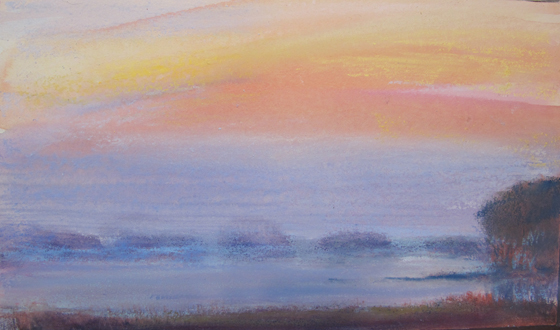
watercolor underpainting with pastel on top
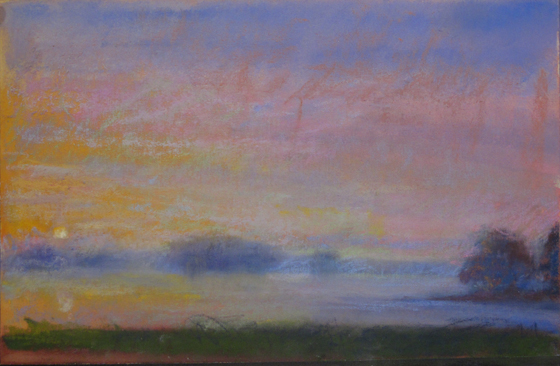
 I have been playing with my underpainting methods as part of my quest for luminescence. I find that certain methods suit different ideas or moods. Not surprisingly the color underneath is the biggest factor with a close second comes the tactile nature of the surface that allows for a different stroke and blending. The sanded paper (Uart 400) has a bouncy layer for the last stroke to rise on top and vibrate with the others. The pastel toned paper is nice to the touch- soft and velvety, but the risk of mud is greater. I may like it better in the studio where my thought and planning is greater. Plein air is more about feeling and responding quickly.

That reminds me of a wonderful quote by one of my young students. We were out on the field plein air painting. He asked me, "Is it OK if I just sit and feel and smell the air, look and paint?" Now there is a young painter who gets it!
pastel underpainting on hand toned pastel paper

Monday, April 29, 2013

difference with an underpainting


lake 1
lake 1 underpainting
 Last week I was playing with my underpaintings. I did two different versions at the same time. Then I painted on the dried underpaintings. Both were done with Nu pastels moistened with mineral spirits. I was looking to see how I respond differently to the underneath colors.
Only the side of the pastel stick was used. The purpose was to keep away from drawing the scene and just respond to the color edges.
lake 2
lake 2 underpainting


Tuesday, May 3, 2011

method of underpaintings

1. one color grisaille
2.one color underpainting
3.two color oil underpainting


4.watercolor full color underpainting


5. watercolor full color underpainting

You wonder, how does an underpainting effect the outcome of a painting? First of all the underpainting is the diving board that every other decision jumps off of.  Whether its the calm one color grisaille or the electric magenta and yellow block-in, the underpainting  informs you for each following decision.
 The one color grisaille(numbers 1 and 2)  is a method where you place all your information down first. Gradually you move away deciding which pieces of information needs to be there and which to throw out. In this method, you are not reading off the color, instead it is the value that informs you.
The two color underpainting (number 3) is a kind of blocking in method. Here you choose the  dominant color, first  in sun and then shadow.  Gradually you refine the shapes and colors. Details come last. I feel I resonate to this method more.
In my pastels I do a full color underpaintings (numbers 4 and 5) and play fully off the colors on the paper. The colors chosen are what I see as the "skeleton of the landscape." The skeleton underpaintings work well in plein air.
What's your underpainting method?

Saturday, March 19, 2011

new paper trial- colorfix suede

Another pastel possibility. I am experimenting with the intensity of the underpainting and what I can do with smoothing and texture. While I experiment for the fun of it I also create them as explorations for later oils. While head thinking an oil I want to know the possibilities of new underpainting.  In a way the pastel is a shortcut as it would take much longer to do the research with oil.
In addition this is a new paper. The people at Dakota Pastels sent me a piece of Colourfix Suede.  I like this paper and I am really fussy about paper. It takes the watercolor quite well and the taped paper didn't buckle a bit. In addition after the watercolor had dried it was easy to smooth the pastel with a finger.  A perfect mix of smooth and  rough the suede has  enough texture so that the pastel will rest on top and vibrate with the underpainting.
Here is what Dakota says,

NEW! ART SPECTRUM COLOURFIX SUEDE
Art Spectrum has added a new line of paper with a less abrasive surface to its family of archival quality pastel papers. The surface of Colourfix Suede is smoother or softer to the touch than the original Colourfix, so is gentler on fingers and tools, yet still holds layers of pastel. It works particularly well with PanPastel and Sofft Tools. The Suede is produced on a heavier weight (500gm) hot press watercolor paper for more rigidity. The surface coating also goes to the edge of the paper to help distinguish it from the original. Colourfix is available in eight colors - six new colors, black and white. The Rainbow Packs have the six colors plus two each of black and white.
We offer a sampler containing one 9 x 12" sheet of each of the 8 colors.
It's on sale at Dakota. Here is the link.

Monday, March 14, 2011

symbolic crossroads and the hamster wheel

6x9 pastel and watercolor on Uart
This is one for my studies for the long oil. Each time I try different ways to get the vision in my head I discover new possibilities. I have found that doing my study paintings in pastel makes painting the oil easier. I play with different underpaintings and color possibilities. This possibility was taken from last night's sunset on the field. Granted it is a soccer field and has no water, but that didn't matter.

As I thought about the symbolic crossroads I have reached in my life I needed to ponder more about the differences during this "time away from life" that I have experienced for the last 3 months. When immersed in my regular life I was constantly processing and multi-tasking. During this time of recovery my time slowed down to a wonderful standstill. It was as if I was at Walden Pond, alone. There were no real expectations of me, except to heal. Very different from life, eh? I lived in my head for the first month and painted from my bed. My ideas grew because they had NO competition for my attention.  I have learned to trust my head and crave silence. I want less activities staking claim to my mind. Yet, still I am not a hermit, and truly love my husband, family and friends. As I prepare to enter my life again I wonder how do I create that environment in this crazy hamster wheel I call life? That is the challenge we all face each day. But, for me, having a glimpse of sanity makes me want more.

Friday, March 11, 2011

experimenting with underpainting

12x24 oil on wood
6x6 oil on wood
I have this idea, yet I haven't a clue how to do it. Somehow I think the secret lies in the underpainting. That leads me to my experimenting. I am planning, rubbing, scraping, scratching. Both these underpaintings are in step two of setting up the colors. Both are on wood...if I don't like it I can sand it off. I want my work to return to the looser nature of my pastels.  To feel light and freedom
On another note, it has been so long since I have been in the field, but the good news is here......starting tomorrow I am able to drive again!!!!! YAY! I can't lift my plein air stuff on my back...yet. but I know plenty of places that I can paint right near the car! I am so excited I can cry! This has been a LONG trip and to tell you the truth it has changed my life for the better. You wonder how can having most of your right lung removed change for the better???? Well, I slowed down and have learned to appreciate differently. I learned to ask for help (something that was taboo.) I learned to trust my painting head in a new way when I had to work only from memory (while painting bedside.) Those are the few things I can write here.... I feel the world opening up again.

Monday, October 4, 2010

experiments with the colors and details of underpaintings


It's funny to me that I am trying hard to get away from description and only paint the essence yet I am creating precise underpaintings. Seems counter productive, eh? You create to take away. I gradually etch away at the underpainting by creating a haze of air and losing more of the precision each time with each layer. That being said, I am experimenting with how much detail is needed to begin with and  how much  to leave. I also am working with the underpainting color. Note on the paintings above:
top: burnt sienna, transparent yellow oxide, and shale-early morning, early autumn, field Olney
middle:shale, slight addition of burnt sienna- nocturne, cooler, darker, tree Whidbey with path
bottom: all burnt sienna-dusk, distance warm, dark mass in front, next door field
I keep the notes so that I can remember. Since I am now working on up to 6 paintings at a time, it's easy to become confused.
Today is the day..my blog is 3 years old.

Saturday, September 11, 2010

"glow" underpainting

I have never been able to create the glow I desire with  a traditional underpainting. So I continue to search for the way that will work for me. The underpainting on the left has been painted with an assortment of colors (cad yellow, alizarin, ultramarine blue, white and sap green)-leaning warm. On the right is the underpainting I posted yesterday with transparent earth yellow rubbed in.
These last three underpaintings were created  of places I know deep down inside of me, I can see them in my sleep. No handshakes this time.
One thing is constant, they are all on gator board, with gesso and sometimes marble dust. Uncertainty is something I relish. Sometimes I think I paint just to amaze me.

Friday, September 10, 2010

underpaintings:colors

Two oil underpaintings. The underpainting is the set-up, it decides the most important things-value and feeling. A couple of things I know:
1. hard edges aren't your friend.
2. make this small statement have a full understanding of the value.
In these two I am playing with the color variable. This one is made in a kind of payne's gray -like color. I mixed ultramarine blue, cad red light and cad yellow to make the "perfect" gray-not warm not cold. I am not quite sure if there is a perfect gray. This underpainting is for an early morning painting...cool light. I think I will add a warm glow layer over it when it dries.
This one is painted in Shale, a color made by Vasari. It's a little warmer than my mix, nice for landscape. Tomorrow I will post a third, one made in "glow colors."

Thursday, August 19, 2010

give yourself permission

9x12 oil (with pastel) on marble dust
So I have been working with oil in the studio, experimenting with surfaces. Recently I have been loving using oil paint on my marble dust boards (that I normally use for pastel.) After a few layers of underpainting in oil I kept trying to get the feeling I wanted. Paint, scrape, paint, scrape, paint wash off. Add pastel, take off pastel, add more oil paint, wipe, scrape..... and on and on....Now, what is it?
After yesterdays' s talk with Marla I kept hearing her words in my head.."nothing is precious..give yourself permission." So, as you notice, I gave myself full permission, And the painting has gone through many metamorphoses. Like a child growing, some phrases are more delightful, some are awkward. No regrets..... because it's not about keeping, it's about exploring.
I am not really looking for another pretty picture.

Wednesday, March 17, 2010

thinking about underpaintings: watercolor vs. pastel

8x8 pastel on BFK This morning's sunrise.

 pastel on watercolor underpainting, Uart

This week Richard wrote about pastel as an underpainting (link here). And then, Sam, after reading it, had some questions in my comment section. I have been fortunate to work with Richard for many years. I consider him my mentor. He is a very gracious, generous teacher with a great sense of humor... not to mention all the amazing information he has stored in his head. (WOW) If you can, treat yourself with one of his workshops.
I learned watercolor underpainting from him. Watercolor makes a vibrant surface from which to work. When used loosely, slip and slosh (the Richard way), it makes a perfect underpainting from which a pastel can evolve, little by little as if solving a mystery. Oil works the same way and is great for studio works. The stain it leaves on the paper is even more intense. Drips and wonderful accidents are all part of the process. To underpaint with either watercolor or oil you need to use a sanded paper. Big paintings must be mounted and small ones can be taped done to a board (UArt paper works great for this.) I used that method to create the bottom painting. Pastelmat accepts watercolor and oil beautifully, although I find that the marks made are firmer and harder to blend.
 Rives BFK is my new favorite. Smooth, yet lightly porous it's a wonderful all purpose pastel paper. When using it I underpaint by rubbing in large shapes or bands of color with a paper towel. It creates a soft feeling (top painting.)
Other options are putting your pastel on a sanded surface and rubbing it in with a paper towel - some times paper towel bits also remain, which is a minor bummer. Pipe insulation is a great tool for blending pastels on sanded paper. It does the work so your wounded fingers are saved. (try that Sam)
Using alcohol or turpentine to move the pastel over the surface is another option. Once again you need sanded paper. I did try this method long ago. I couldn't get past the idea of making pastel do  paint's job...why not use paint? A bias of mine I guess.
Water is a method  for moving pastel which I don't like. I think it is clumpy and my bias is still there.
Everyone has his/her preferences and those are mine. If you have a new way to add please let us know.
Happy painting, whichever way you choose!